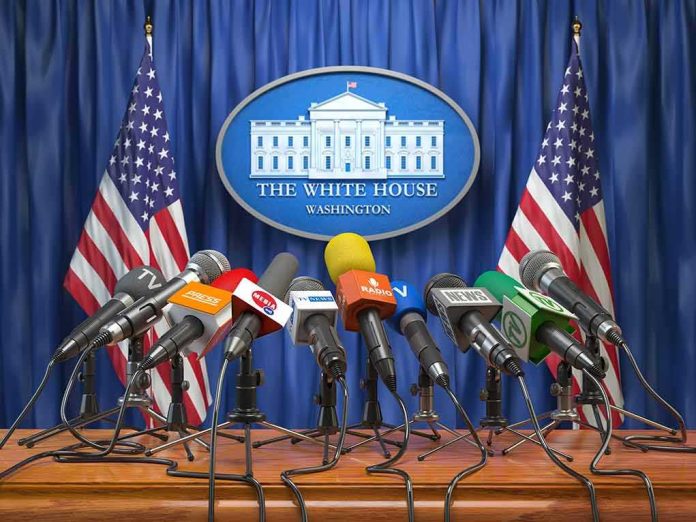
A federal judge appointed by President Trump just ruled that the White House likely broke the law when it stripped three news outlets of their press badges.
Quick Take
- U.S. District Judge Timothy Kelly issued a preliminary injunction on October 14, 2026, restoring White House access for CNN, MS NOW, and POLITICO.
- President Trump first said he pulled the credentials over “negative stories,” then the administration later shifted to a national security argument.
- The Justice Department says White House access is a “privilege, not a right,” and claims the outlets published sensitive or classified material.
- The ruling leans on a 50-year-old court precedent that requires the government to give reporters notice and a chance to respond before yanking their passes.
What The Judge Actually Decided
Judge Kelly’s preliminary injunction keeps reporters from CNN, MS NOW, and POLITICO inside the White House complex while the lawsuit continues. He found the ban likely amounted to “retaliation” and “viewpoint discrimination” against outlets whose coverage angered President Trump. The order builds on an earlier temporary restraining order that found the White House skipped basic due process when it revoked the credentials without warning.
Kelly reportedly focused on one detail that undercut the administration’s case: the stated reason for the ban changed over time. Reporting says Trump first complained about unfavorable coverage, and only later did officials pivot to a national security explanation. Courts tend to distrust shifting justifications, and Kelly’s opinion reportedly flagged that inconsistency as evidence the ban was really about punishing coverage, not protecting secrets.
The White House’s National Security Defense
The Justice Department pushed back hard, arguing that stepping onto White House grounds is a privilege the president can grant or take away, not a constitutional entitlement. Officials said the three outlets failed to meet “minimum standards of professionalism and decorum” and had published classified or sensitive material tied to national security. That is a serious allegation, and if true, it deserves scrutiny separate from the politics of the fight.
The administration pointed to specific incidents: CNN’s reporting on construction details tied to a White House bunker, MS NOW coverage of an alleged leak probe, and a POLITICO story describing ballroom funding that included Secret Service security details. The White House argues those stories crossed a real line. The outlets counter that the complaints look like after-the-fact cover for punishing coverage the president disliked.
A Fifty-Year-Old Precedent Looms Over The Case
Much of this fight traces back to a 1977 case, Sherrill v. Knight, where a federal appeals court ruled the White House cannot arbitrarily yank a reporter’s credentials once it has opened its press facilities to working journalists. That ruling requires notice of the reason, a chance to respond, and a written decision. Legal experts say it gives the news organizations a strong procedural footing, regardless of how the underlying security dispute shakes out.
The Justice Department has asked courts to throw that precedent out entirely, calling it wrongly decided. That is a notable ask. Overturning a rule that has governed White House press access for five decades would hand future presidents of either party far more power to exclude reporters whose coverage they dislike, a trade-off conservatives who value limited, predictable government power should weigh carefully.
A federal judge has extended an order restoring White House press access for CNN, MS NOW and POLITICO, according to multiple reports. The outlets will retain access while litigation over the media restrictions continues. CNN reports that the judge said the ban likely violates the… pic.twitter.com/OmhcX79JXj
— Cool X Media Group (@teslamillion) October 14, 2026
None of this settles the underlying question of whether the three outlets actually mishandled sensitive information. That dispute remains unresolved, and Kelly’s order is a preliminary finding, not a final verdict after a full trial. The administration has signaled it will likely appeal, meaning this fight over presidential authority, press access, and due process is far from finished.
Sources:
thegatewaypundit.com, cnbc.com, cnn.com, politico.com, fortmorgantimes.com