
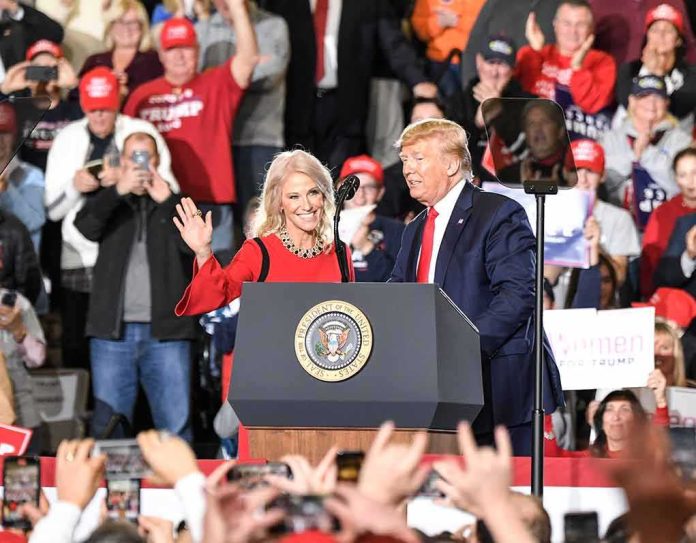
Donald Trump just turned a Texas Senate runoff into a public loyalty test, and the result sent a shockwave through the Republican establishment.
Story Snapshot
- Ken Paxton crushed incumbent John Cornyn in the Texas Republican Senate runoff after a late Trump endorsement.[1][2]
- Trump congratulated Paxton as a “Texas sized” winner and openly aligned himself against the state’s old guard Republicans.[1]
- The race became a referendum on “RINO” politics versus the Make America Great Again movement’s grip on the party.[1][2]
- Democrat James Talarico now faces a Trump-backed, battle-tested opponent in a deeply polarized general election.[2]
Trump Turns a Senate Seat into a Loyalty Test
Texas voters did not just pick a Senate nominee; they chose sides in a civil war inside the Republican Party. Texas Attorney General Ken Paxton, already a hero to the Make America Great Again base after surviving impeachment, toppled four-term Senator John Cornyn in a Republican runoff that was nationalized the moment Donald Trump weighed in.[1][2] Trump’s late-stage endorsement told primary voters exactly what the choice meant: back Paxton, or stand with the Washington establishment Cornyn came to embody.[1][2]
Trump had already framed Paxton as a fighter the system tried and failed to take down when he celebrated Paxton’s acquittal on all sixteen impeachment articles as a “great and historic Texas sized VICTORY.”[1] He praised Paxton’s “wonderful wife and family” for enduring the ordeal, signaling that the Paxtons were not just allies but part of his political tribe.[1] That language matters, because when Trump later told voters to send Paxton to the Senate, it sounded less like an endorsement and more like a field promotion.
How Cornyn Became the Example, Not the Exception
John Cornyn did not simply lose a campaign; he lost a verdict on a career built inside the party machinery. Cornyn had seniority, fundraising networks, and every credential the old Republican guard used to respect. Yet Texas Republicans watched him clash with Trump and hesitate on core Make America Great Again priorities, and that hesitation became deadly in a primary framed as “which side are you on.”[2] When Paxton’s Trump-backed surge landed, Cornyn’s experience looked like baggage, not ballast.[1][2]
This was not a fluke protest vote in a low-turnout race; coverage described Paxton’s win as an easy defeat of Cornyn, a thrashing driven by a late endorsement that supercharged an already simmering base revolt.[1][2] From a common-sense conservative perspective, the lesson is simple: in red states, loyalty to voters’ priorities and the former president now outweighs tenure in Washington. When an incumbent repeatedly signals more comfort with bipartisan cocktail hours than with border security crackdowns, primary voters eventually issue their own term limits.
Paxton’s Baggage, the Base’s Message, and Conservative Calculus
Critics on the left and within the Republican establishment continue to hammer Paxton’s ethics controversies and impeachment history, treating his victory as proof that the base will overlook anything if Trump snaps his fingers.[1] That narrative ignores a crucial fact: Paxton’s impeachment charges went to trial in the Texas Senate, and senators voted to acquit him on all sixteen counts, returning him to office.[1] Voters saw a legal process, a clean acquittal, and then a political class that refused to move on. That disconnect fueled, rather than diminished, his appeal.
From a conservative, rule-of-law standpoint, Americans have long accepted a basic principle: if the system tries you and you are acquitted, you do not get treated as guilty forever. When media outlets and political opponents insist on treating acquittal as a mere technicality, they look less like watchdogs and more like partisans who refuse to take “not guilty” for an answer. Voters in Texas appear to have concluded that if the establishment keeps prosecuting the same man in the court of public opinion, the establishment might be the problem.[1]
The Coming Clash with James Talarico and What It Signals
Paxton now heads into November against Democrat James Talarico, who has already been cast by Republicans as a progressive threat in a conservative state.[2] Paxton and his supporters frame Talarico as the kind of nationalized left-wing politician who would rubber-stamp the Biden administration’s spending, green mandates, and lenient border policies. Trump’s promise of “big, beautiful rallies” for Paxton is not just rhetorical flourish; it is a signal that he plans to make this race a centerpiece of his 2026 map and a test of his enduring pull in a massive red state.[2]
Trump ally Ken Paxton defeats Sen. John Cornyn in Texas’ bitter Republican primary war. Trump targeted Cornyn as "VERY disloyal" as he backed Paxton, a MAGA firebrand, in the final days of the runoff campaign. pic.twitter.com/keVsCZL3KO
— Eulalia (@Eulalia2432) May 27, 2026
For conservatives who care about judicial nominations, border enforcement, and reining in the federal bureaucracy, the Paxton–Cornyn–Talarico triangle offers a clear contrast. Cornyn represented the methodical, incremental Republican who often negotiated the edges off conservative priorities in the name of compromise. Paxton represents a more confrontational style that prioritizes outcomes over bipartisan elegance. Talarico represents a Democratic Party increasingly comfortable with expansive federal power. Texas voters have already said which flavor of Republican they prefer; the country will now see whether that choice becomes the template for future intraparty revolts.
Sources:
[1] Web – JUST IN: Trump Congratulates Paxton on Epic Victory to Unseat RINO …
[2] Web – Trump congratulates Paxton on “Texas sized” impeachment victory