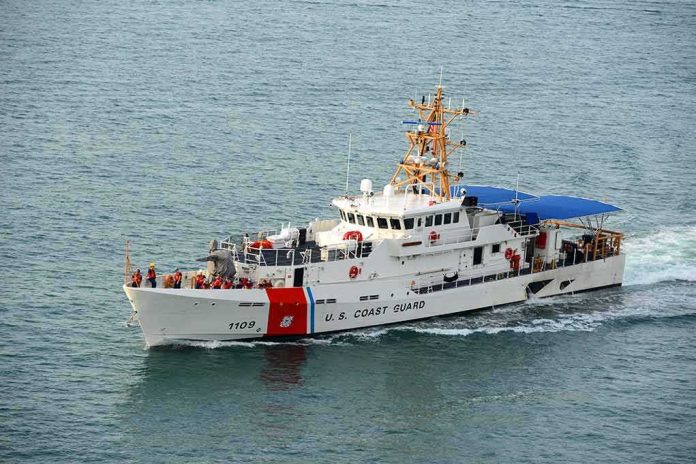
Fifty miles off Puerto Rico, a Coast Guard crew cut three tons of cocaine out of the Caribbean’s shadow economy and kept it from our streets.
Story Snapshot
- Coast Guard Cutter Richard Dixon stopped a suspected smuggling boat near Puerto Rico.
- Crews seized about 7,250 pounds of cocaine worth about $54.5 million.
- Five people were detained, and the drug boat was destroyed as a hazard.
- The bust fits a long pattern of big seizures in Puerto Rico’s waters.
What Happened On The Water
Coast Guard Cutter Richard Dixon intercepted a suspected smuggling boat on Saturday, August 22, about 50 miles off Puerto Rico, with help from Customs and Border Protection air and marine teams. Boarding crews found more than 7,000 pounds of cocaine packed for transit. Coast Guard officials estimated the haul at about 7,250 pounds, worth about $54.5 million on the wholesale market. Five people aboard were detained. The Coast Guard destroyed the vessel after deeming it a hazard to navigation.
This case follows a steady stream of Caribbean interdictions that start far from any pier and end in federal custody at Coast Guard Base San Juan. The Coast Guard, working with Homeland Security Task Force partners in the San Juan Region, repeatedly reports go-fast boat stops, bale counts, and handoffs to the Drug Enforcement Administration. In one recent case north of Puerto Rico, crews seized 29 bales weighing 2,083 pounds and offloaded them in San Juan.
Why Puerto Rico’s Seas Stay Busy
Traffickers favor the Puerto Rico corridor because it offers speed, cover, and routes that can thread through gaps in patrol patterns. The Coast Guard and partners counter with cutters, fast boats, aircraft, and radar cueing. Over the years, those assets surged and spread across known lanes. A Government Accountability Office review found Coast Guard drug-interdiction vessel hours in Puerto Rico and the U.S. Virgin Islands more than tripled from 2009 to 2013, showing deep, sustained focus on this fight.
Seizures around Puerto Rico also show a repeatable playbook that reflects basic common sense: push the border out to sea, cut supply before it hits land, and turn defendants over to federal prosecutors. Crews board, secure evidence, and move the drugs and suspects to San Juan. The Coast Guard has detailed several operations with named cutters, exact bale counts, and formal transfers to the Drug Enforcement Administration, which helps close the loop from patrol stop to prosecution.
How This Fits The Larger Pattern
The Richard Dixon case is not a one-off headline; it is part of a drumbeat. Crews north of Loiza offloaded 2,513 pounds from a 30-foot go-fast and moved suspects to federal agents in Mayaguez. That case named the cutter, the weight, and the chain of custody in clear terms. Another operation disrupted a smuggling run north of Puerto Rico and offloaded more than a ton in San Juan. Each action adds weight to a simple truth: consistent patrol pressure forces cartels to risk more and lose more at sea.
Coast Guard seizes 7K pounds of cocaine worth more than $54 million near Puerto Rico, five arrested https://t.co/3ztjPX4Lf6 #FoxNews
— Liz V (@ShoreEJV) August 27, 2026
Some people argue that seizing drugs at sea is a game of whack-a-mole. That view ignores the direct wins for public safety and border control. Every bale stopped offshore is one less pile on a U.S. block. American conservative values prize law, order, and secure borders. Maritime interdictions deliver all three. They also keep pressure on cartels to choose riskier routes, expose logistics networks, and create more chances to catch organizers, not just couriers.
What Comes Next After A Big Bust
After a major seizure, the process moves from deck-plates to case files. Agents catalog the cocaine, interview detainees, and refer charges to federal prosecutors. The pipeline in Puerto Rico handles these steps often, which helps speed court actions and keep the chain of custody tight. Recent cases in the region have led to indictments that charge conspiracy to import cocaine and related offenses, showing that at-sea stops can drive courtroom outcomes.
The August 22 interdiction also sends a message to smugglers gaming the sea lanes. Air and marine sensors can spot low-profile craft. Fast-response cutters can close the gap quickly. Boarding teams can seize loads before a runner ever sees shore. When that happens again and again, cartels must spend more to move the same weight. That erosion of profit is not newsy, but it is how borders hold over time.
Sources:
facebook.com, foxnews.com, content.govdelivery.com, southcom.mil, justice.gov