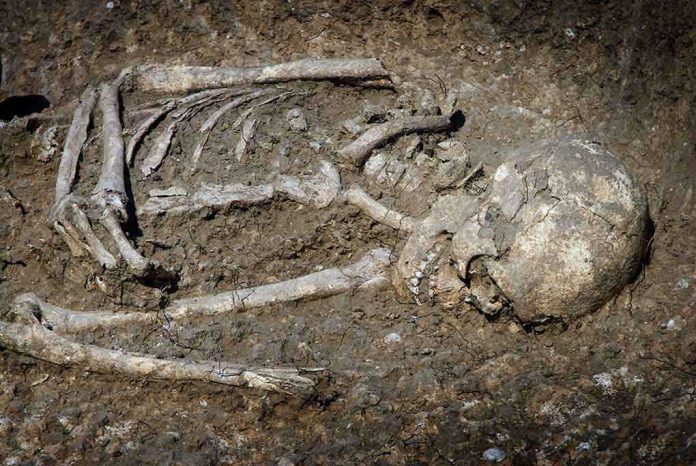
773,000-year-old bones from a Moroccan cave might pinpoint the family tree spot where all modern humans forked from our extinct cousins.
Story Snapshot
- Fossils dated to 773,000 ± 4,000 years ago using Earth’s magnetic flip as a global clock.
- Mosaic traits blend primitive teeth with advanced jaws, linking Africa to early Europeans.
- Discovered in a carnivore den after 30 years of digs by Moroccan-French teams.
- Positioned as sister group to Homo sapiens, Neanderthals, and Denisovans split.
- Challenges timelines, fills fossil gap with precise dating unmatched in Africa.
Thomas Quarry I Fossils Dated Precisely
Thomas Quarry I in southwestern Casablanca, Morocco, yielded hominin remains including adult and child mandibles, a gnawed femur, vertebrae, and teeth. Researchers dated these to 773,000 ± 4,000 years ago. They analyzed 180 magnetostratigraphic samples capturing the Matuyama-Brunhes reversal, Earth’s polarity flip around 773,000 years ago. This global event pinned the fossils to a narrow 8,000-11,000-year window in layered cave sediments once used as a carnivore den.
Associated animal bones confirmed the age. The site preserved high-quality layers from decades of stratigraphic work under the Préhistoire de Casablanca program. This precision stands out in Pleistocene dating, where African hominin timelines often lack such anchors. Common sense affirms the method’s reliability, as geomagnetic shifts provide independent verification worldwide.
Mosaic Traits Bridge Evolutionary Gap
Micro-CT scans revealed primitive teeth without Neanderthal features alongside derived jaw structures. Shara Bailey from NYU noted the dental shapes differ markedly from later Neanderthals. These traits position the fossils as an African population near the root of Homo sapiens, Neanderthals, and Denisovans. Jean-Jacques Hublin called them a sister group to Homo antecessor from Spain’s Gran Dolina site 800,000 years ago.
The morphology suggests pre-divergence connections between African and Eurasian lineages. This fills a fossil-poor period around 773,000 years ago, building on earlier Homo erectus-like forms. Facts support viewing them as basal rather than direct ancestors, aligning with conservative caution against overhyping fragmentary evidence.
Decades of Moroccan-French Collaboration
The Préhistoire de Casablanca program ran over 30 years, partnering Morocco’s INSAP with French teams. Serena Perini from Max Planck Institute led the magnetostratigraphy, praising the record’s resolution. Discoveries emerged from phosphate quarry excavations since the 1990s. Long-term trust enabled access and analysis, with Max Planck and NYU driving publication in Nature early 2026.
Hublin as principal investigator shaped interpretations. Nature editors peer-reviewed the claims. This international effort underscores shared scientific pursuit over national rivalries, a model of productive collaboration rooted in mutual respect for evidence.
Expert Views and Media Hype Clash
Perini highlighted the “exceptionally precise chronological framework.” Bailey emphasized primitive dental features. Hublin framed the fossils as key to the sapiens-Denisovans-Neanderthal split, estimated 500,000-800,000 years ago. Popular Archaeology illuminated shared ancestry. ScienceDaily stressed the pivotal branching point.
A skeptic at ScienceandCulture dismissed “missing link” hype, noting the bones appear “within Homo sapiens or highly human-like.” This critique aligns with common sense: continuity in human traits this far back tempers sensational claims. Mainstream consensus holds on dating and morphology but debates exact ancestral status.
Implications Reshape Human Origins
Short-term, the study refines Pleistocene dating techniques. Long-term, it bolsters Africa’s role in shared human ancestry and hints at early dispersals. Paleoanthropologists adjust models for the sapiens-archaic split. INSAP promotes Moroccan sites, potentially boosting science funding and tourism. Socially, it reinforces human unity from common roots.
Politically, it strengthens Morocco-France ties. Broader effects advance magnetostratigraphy and migration hypotheses in evolutionary biology. Facts suggest measured optimism: solid data fills gaps without rewriting all textbooks overnight.
Sources:
These 773,000-year-old fossils may reveal our shared human ancestor
Human Ancestors in Morocco Reveal an African Lineage Near the Root of Homo sapiens
Early hominins from Thomas Quarry I (Morocco)
Early Hominins from Morocco Reveal an African Lineage Near the Root of Homo sapiens
Teeth, Jawbones, and Vertebrae Fuel Overblown Media Claims of a Missing Link