Antarctica’s most iconic resident just became a harbinger of planetary crisis, with emperor penguins officially joining the endangered species list as their icy realm vanishes beneath them.
Story Snapshot
- IUCN upgraded emperor penguins from Near Threatened to Endangered in April 2026, marking the first Red List change explicitly tied to projected sea ice loss
- Satellite data revealed a 10% population loss—over 20,000 adults—between 2009 and 2018, with breeding failures linked directly to early ice breakup
- Climate models project a 50% population crash by the 2080s and near-extinction by 2100 under high-emissions scenarios
- Antarctic fur seals received the same Endangered designation simultaneously, escalating from Least Concern in an unprecedented double downgrade
- Conservation leaders demand urgent government decarbonization, framing the listing as a “stark warning” requiring multi-sector climate action
The Ice-Dependent Species Facing Obliteration
Emperor penguins breed exclusively on Antarctic sea ice, requiring stable frozen platforms to raise chicks through brutal winter conditions. The species’ estimated 595,000 adults rely on precise timing: ice must form early enough for breeding yet remain intact through months of chick development. When sea ice breaks prematurely, downy chicks plunge into frigid waters and drown before developing waterproof plumage. Satellite monitoring intensified after 2000 to track climate impacts, revealing vulnerability scientists long suspected but couldn’t quantify until technology caught up with the vastness of Antarctica’s frozen coastline.
A Decade of Documented Decline
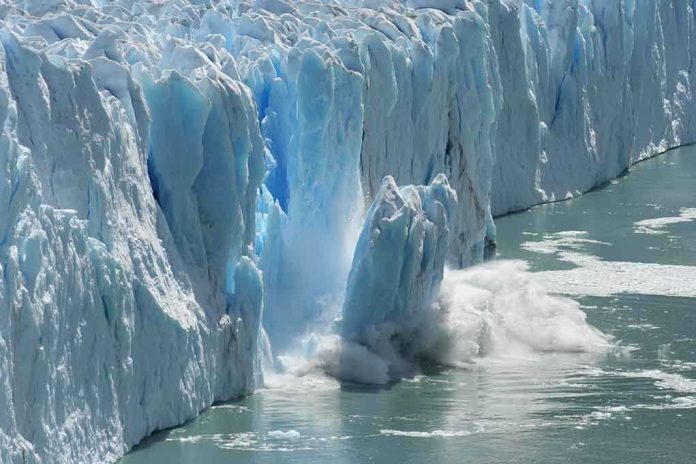
Between 2009 and 2018, researchers documented the disappearance of more than 20,000 adult emperor penguins—a 10% population hemorrhage traced to collapsing breeding colonies. Antarctica’s sea ice extent plummeted to record lows during this period, accelerating a decline underway since the 1970s. Early ice breakup stranded entire cohorts of chicks, while reduced ice coverage constricted access to krill, the penguins’ primary food source. Extreme events like massive glacial calving compounded the crisis, obliterating nesting sites and forcing survivors into increasingly marginal habitat where survival odds plummet with each reproductive cycle.
The Official Reckoning
The International Union for Conservation of Nature announced the Endangered listing in April 2026, upgrading emperor penguins from their previous Near Threatened status. The decision rested on satellite imagery, field observations, and climate modeling aligned with IPCC projections under the RCP8.5 high-emissions scenario. Antarctic fur seals received an identical upgrade, vaulting from Least Concern to Endangered in what conservation biologists called an alarming parallel precedent. Dr. Grethel Aguilar, IUCN Director General, declared the findings “should spur action across sectors to address climate change,” while BirdLife International CEO Martin Harper warned governments must decarbonize urgently or watch species extinction unfold in real time.
The Grim Mathematics of Extinction
Climate models paint a merciless future: emperor penguin populations will halve by the 2080s if current emission trajectories persist, with near-total extinction by 2100. Most colonies will lose viable habitat as sea ice vanishes from breeding zones, leaving scattered remnants clinging to increasingly unstable ice formations. The krill population, already under pressure from warming waters and industrial harvesting, faces disruption that cascades through the Antarctic food web. Scientists emphasize these aren’t abstract projections but mathematical certainties derived from observed ice loss rates, breeding biology constraints, and thermal thresholds the species cannot adapt around within evolutionary timescales measured in millennia, not decades.
What the Listing Triggers
Endangered status activates enhanced monitoring protocols, conservation funding channels, and political pressure mechanisms within international treaty frameworks like the Antarctic Treaty System. The designation compels Paris Agreement signatories to confront the tangible costs of delayed decarbonization, transforming emperor penguins into living evidence of climate policy failures. Tourism operators and krill fisheries face potential new restrictions in Southern Ocean waters, while research communities dependent on stable ice for Antarctic stations grapple with their own operational uncertainties. The economic ripples extend beyond conservation budgets into fishery management, geopolitical negotiations over Antarctic resources, and the credibility stakes surrounding climate modeling that policymakers have long questioned or dismissed.
The emperor penguin’s descent toward oblivion represents more than one species’ struggle—it’s a test of whether human institutions can respond to existential warnings before extinction becomes irreversible. Conservation organizations now possess authoritative ammunition to demand binding emissions commitments, but the ice clock ticking beneath Antarctic colonies cares nothing for political timelines or bureaucratic inertia. Whether these tuxedoed sentinels survive past this century depends entirely on decisions made in capitals thousands of miles from their frozen realm, where the abstract language of climate diplomacy must somehow translate into the concrete physics of ice preservation before mathematics renders all intervention futile.
Sources:
“Stark Warning” As Emperor Penguins Added To Endangered List Amid Rapid Decline
Emperor Penguin and Antarctic Fur Seal Now Endangered Due to Climate Change – IUCN
Emperor Penguin Now Endangered Due to Climate Change – BirdLife International