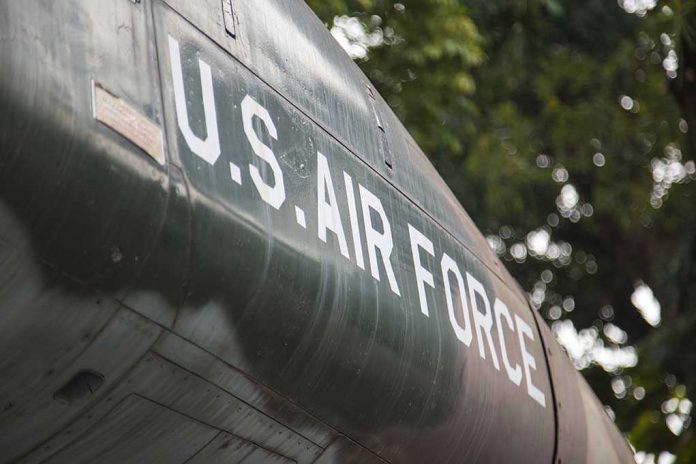
A single security breach at a “neutral” Irish airport was enough to put a U.S. military cargo aircraft at risk—raising fresh questions about how exposed American assets are overseas.
Quick Take
- A man in his 40s breached restricted areas at Ireland’s Shannon Airport and struck a parked U.S. Air Force C-130 with a hatchet/axe, according to multiple reports.
- Irish police arrested the suspect after the incident; authorities have not released a motive, and the extent of damage is still being assessed publicly.
- Shannon’s long-running role as a U.S. military stopover has made it a recurring flashpoint for activism, and it has seen other perimeter breaches in recent years.
- The “$75 million” damage claim circulating online is not confirmed in the reporting provided; some outlets describe the damage as “extensive” without a dollar figure.
What Happened at Shannon Airport—and What’s Confirmed So Far
Irish authorities arrested a man in his 40s after he breached security at Shannon Airport in County Clare on April 11, 2026 and attacked a U.S. military aircraft on the tarmac. Reports say the man climbed onto the wing of a U.S. Air Force C-130 Hercules and struck the fuselage with a hatchet or axe. The airport temporarily suspended operations during the response before resuming service later that morning.
Multiple outlets broadly agree on the basic timeline: the aircraft had landed at Shannon the prior day, the breach began around mid-morning, and the suspect was taken into custody around 11 a.m. Irish Gardaí said the investigation remains ongoing, including how the suspect accessed restricted space and the specific scale of the damage. Some accounts describe “extensive” damage, but publicly available details remain limited while the inquiry continues.
Why This Airport Keeps Showing Up in U.S. Military Security Stories
Shannon is not just another regional airport. It has served as a refueling and stopover point for U.S. military aircraft for decades, with its role expanding significantly after 9/11 as American forces moved through Europe toward the Middle East and beyond. That long-standing arrangement, alongside Ireland’s stated neutrality, has fueled recurring political controversy inside Ireland and has made the airport an attractive target for protest—and, at times, direct interference.
The latest incident follows a pattern of prior disruptions and alleged vandalism tied to U.S.-linked flights at Shannon. Reporting cited earlier breaches including a van incursion in late 2025 and other fence or perimeter incidents in 2025, as well as a December 2025 case involving activists accused of spray-painting a U.S. aircraft. A well-known historical precedent dates to 2003, when anti-war protesters were accused of damaging a U.S. military plane with tools during Iraq War-era protests.
The Hard Question: How Did a Civilian Reach a U.S. Aircraft in a Restricted Zone?
The most politically significant detail is not the attacker’s rhetoric—none has been confirmed—but the practical failure: a lone individual reached a U.S. aircraft inside a restricted area at a mixed civilian-military hub. For Americans who already distrust “we’ve got it handled” assurances from institutions, that’s the kind of real-world vulnerability that cuts through partisan narratives. A plane doesn’t have to be destroyed to become mission-impaired, delayed, or costly to repair.
Irish officials have not publicly detailed whether the breach involved a fence cut, a gate failure, insider access, or another vulnerability, and U.S. authorities have not released a public accounting in the provided reporting. Still, even a short shutdown underscores the stakes: when security is porous, the response quickly spills into civilian travel, local policing costs, and international coordination. In a world of lone-actor threats, “small” breaches can become big headlines fast.
What the “$75 Million” Claim Gets Wrong—and What We Still Don’t Know
Online posts have framed the episode as a “$75 million” attack on a U.S. “war plane,” but that specific figure is not substantiated by the reporting provided. Some sources describe the damage as “extensive,” and a C-130’s value can vary by model, age, and configuration, but none of the cited articles in the research clearly verify a $75 million damage assessment. For readers trying to stay grounded, the responsible takeaway is uncertainty: cost and operational impact have not been officially quantified in these reports.
The bigger policy question is what happens next. If Irish authorities tighten security, that may reduce future breaches but could also inflame domestic debates about neutrality and U.S. military access. If security remains lax, the risk to American assets—and to public confidence in the institutions tasked with protecting them—stays on the table. For both conservatives and liberals skeptical of entrenched bureaucracies, this incident is a reminder that basic competence still matters.
Sources:
Man climbs onto US military aircraft in Ireland, attacks it with hatchet: report
Man allegedly attacks US military plane with hatchet at Shannon Airport in Ireland
WATCH: Axe-Wielding Man Attacks U.S. C-130 Cargo Plane At Irish Airport
Attack with an axe on a US military plane in Ireland!