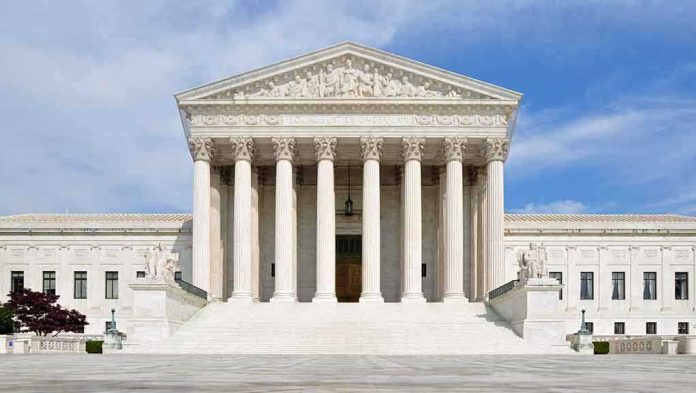
The Supreme Court just handed a 6-3 defeat to President Trump’s effort to end birthright citizenship — and conservative commentator Scott Jennings says the ruling is an “abomination” that foreign adversaries like China are actively exploiting.
Story Snapshot
- The Supreme Court voted 6-3 to strike down Trump’s executive order limiting birthright citizenship, with Chief Justice John Roberts writing the majority opinion.
- Three conservative justices — Samuel Alito, Clarence Thomas, and Neil Gorsuch — dissented, with Alito calling it a “serious mistake.”
- Scott Jennings warned that the ruling benefits foreign adversaries, pointing to organized “birth tourism” schemes run by wealthy Chinese nationals to secure U.S. citizenship for their children.
- Changing birthright citizenship now would require a constitutional amendment — a two-thirds vote in Congress and approval from three-quarters of states.
The Ruling: What the Court Decided
The Supreme Court ruled on June 30, 2026, in Trump v. Barbara that children born in the United States to parents who are here illegally or temporarily are U.S. citizens at birth. Chief Justice John Roberts wrote the majority opinion, saying the 14th Amendment’s language is clear. The ruling struck down Trump’s executive order, which he signed on his first day back in office in January 2025. The vote was 6-3.
Trump had argued the phrase “subject to the jurisdiction thereof” in the 14th Amendment meant that children of undocumented immigrants should not get automatic citizenship. Roberts and four other justices rejected that reading outright. Justice Brett Kavanaugh agreed the order was unlawful but based his view on federal law rather than the Constitution. The ruling upholds a legal principle that has stood since the Supreme Court’s 1898 decision in United States v. Wong Kim Ark.
Three Justices Push Back Hard
Justices Alito, Thomas, and Gorsuch all dissented. Alito said flatly that “the court has made a serious mistake.” Thomas wrote a 91-page dissent — more than three times as long as Roberts’ opinion — arguing the 14th Amendment has been “repurposed for political projects” far beyond its original goal of protecting formerly enslaved Americans after the Civil War. Their dissents show that the conservative legal argument against automatic birthright citizenship is serious, even if it lost this round.
Thomas and Alito’s dissents carry weight in conservative legal circles. The 14th Amendment was written in 1868 to guarantee citizenship to freed slaves — not to create a system where any child born on U.S. soil automatically becomes a citizen regardless of how their parents entered the country. Critics argue the court majority ignored that original intent. Still, the majority opinion is now binding law, and changing it would require either a new constitutional amendment or a future court willing to reverse course.
Jennings: Foreign Adversaries Are Exploiting This
Scott Jennings, a conservative commentator, called the ruling an “abomination” and warned that it benefits foreign adversaries. He pointed specifically to China, noting that federal prosecutors have brought visa fraud cases against wealthy Chinese nationals who paid companies to arrange births on U.S. soil — a practice known as “birth tourism.” The goal is simple: get the child a U.S. passport, which opens the door to education, residency, and eventually full citizenship rights.
Jennings noted that foreign adversaries have entire businesses built around exploiting birthright citizenship. Trump called the policy “tremendously destructive” and pointed out that the U.S. is one of very few developed nations that still grants automatic citizenship based on place of birth alone. While the birth tourism industry is real — and has led to federal prosecutions — no large-scale data currently exists on how many such cases occur each year or how much they affect overall immigration numbers.
What Comes Next for Conservatives
The ruling leaves conservatives with a narrow path forward. Courts have consistently blocked every attempt to limit birthright citizenship through executive orders or legislation. Legal experts say the only sure way to change the policy is a constitutional amendment — which requires a two-thirds vote in both the House and Senate, plus approval from 38 states. That is an extremely high bar. Short of that, a future Supreme Court majority would have to be willing to overturn 128 years of settled precedent dating back to 1898.
For now, the ruling stands as a significant loss for the Trump administration’s immigration agenda. Three of the court’s conservative justices made clear they believe the majority got it wrong. Jennings and other conservatives argue the decision ignores real national security and sovereignty concerns — including the organized exploitation of U.S. citizenship laws by foreign nationals. Whether Congress takes up a constitutional amendment remains to be seen, but the court has spoken, and the path to change just got much harder.
Sources:
twitchy.com, constitutioncenter.org, bbc.com, youtube.com, aclu-nh.org, cfr.org, apnews.com, nbcnews.com, npr.org, news.wttw.com, fam.state.gov, aclu.org, supremecourt.gov, americanimmigrationcouncil.org, law.virginia.edu