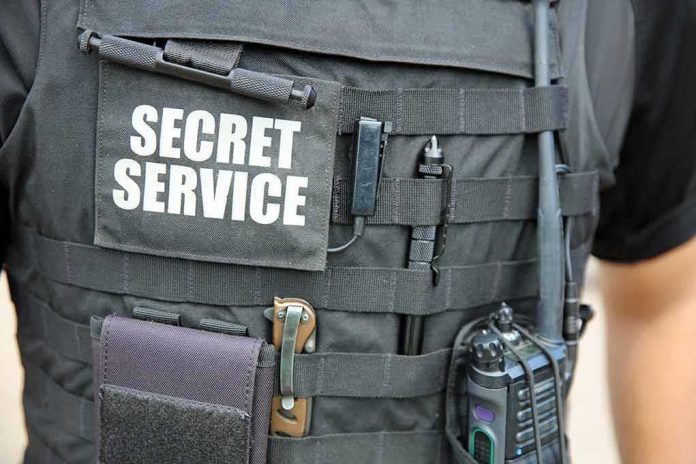
Three Secret Service communications officials, including the agency’s communications chief, were escorted out of headquarters and had their clearances pulled during a leak probe tied to presidential security.
Story Snapshot
- Three Secret Service communications staff placed on leave and stripped of clearances.
- Office of Professional Responsibility leading the review; non-law-enforcement employees involved.
- Reports link the probe to Trump’s covert Turkey-to-Britain plane swap amid an Iran threat.
- Outside reporting says Federal Bureau of Investigation (FBI) and Central Intelligence Agency (CIA) are looped in.
What Triggered The Housecleaning
The Secret Service confirmed three non-law-enforcement employees were put on administrative leave for potential misconduct, with the Office of Professional Responsibility running the case. Multiple outlets identified them as communications office staff, including Chief of Communications Anthony Guglielmi, and reported they were escorted from the building and designated “do not admit,” which matches standard security protocol when clearances are suspended. That step protects sensitive systems while investigators sort fact from rumor. It also signals senior leadership views the risk as non-trivial.
Coverage linked the review to sensitive details around President Trump’s clandestine plane swap in Turkey. The Washington Post reported that an Iranian assassination threat prompted a covert exfiltration plan that used a decoy Air Force One, while Trump flew on a different military aircraft to Britain. Reuters detailed the mechanics, including a catering truck ruse to move him without public detection. Such choreography relies on strict information control. A leak about timing, routing, or cover methods can endanger lives and expose tradecraft.
The Security Stakes Around Trump’s Secret Flight
President Trump publicly said the Secret Service and the military pushed the plane change because of a threat, confirming the core of the safety decision. News accounts added that some intelligence officers had low confidence in parts of the threat stream, but the agency still elevated security, which is common sense when risk to a president is even remotely plausible. Conservative readers know the rule: when it is life or death, err on the side of caution. You can debate analysis later; you cannot undo a successful hit.
Reports said both the FBI and the CIA were involved in the current inquiry, which would be notable for a personnel case and consistent with a matter that touches classified sources or methods. That does not prove criminal charges are coming. It does show the government routed the issue through the national security lanes, not just human resources. When an operation spans protection, intelligence, and deception planning, the circle of need-to-know gets very small. Any unauthorized disclosure becomes far more serious.
Why Communications Staff Are Central In A Protection Crisis
Communications professionals sit at the junction of operations and information. They draft statements, deconflict media narratives, and coordinate what can be said when an active operation is in motion. During a decoy-plane scenario, a single hint can burn the ruse. That is why agencies suspend access first and ask questions second. This mirrors past national security leak playbooks where leave and clearance pulls came early while facts developed, including at the Pentagon in a separate case. The method protects missions without pre-judging outcomes.
Recent months primed this escalation. In July, a member of Vice President JD Vance’s protective detail faced an internal review and possible criminal inquiry over alleged disclosures tied to travel security. The public statements then stressed a bright line: behavior that could threaten a protectee will not be tolerated. Today’s actions follow that same doctrine. Protect the principal first. Lock down access. Then sort intent, harm, and accountability inside formal channels.
How This Aligns With Protection Priorities
The Secret Service uses a layered defense model: intelligence, deception, timing control, and strict communications discipline. The Turkey-to-Britain swap shows those layers at work under stress. If leaks chipped at any one layer, leadership had to act fast. The facts we have support that sequence: a real protective response to a reported threat, a complex cover movement, and now a high-side investigation focused on communications access and handling. That aligns with conservative common sense: safeguard the mission, then clean house if needed.
Sources:
thegatewaypundit.com, yahoo.com, washingtonpost.com, newsbreak.com, democracynow.org, bbc.com, aa.com.tr, secretservice.gov