
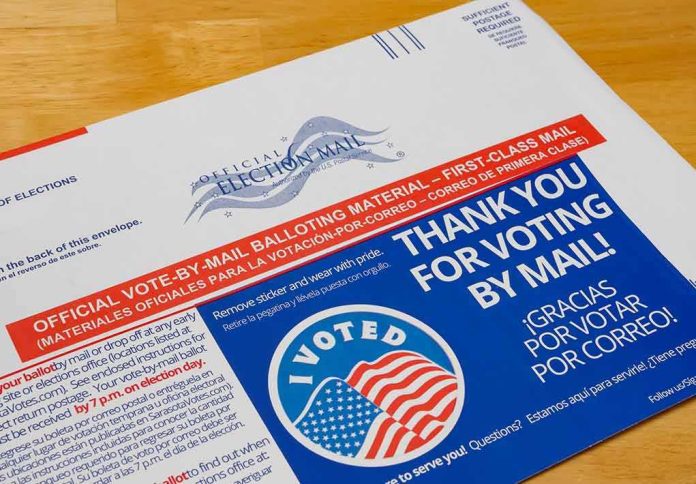
The Justice Department just asked a federal court to stop California from counting some mail ballots until the state proves the voters are citizens—and it handed over a list topping 20,000 names to back it up.
Story Snapshot
- Federal officials sued California days before ballots are counted, citing more than 20,000 “likely” noncitizens.
- The government sent a password-protected list and asked the state to verify names before tabulation.
- California leaders pushed back, saying the data was not verifiable and the transfer was insecure.
- The lawsuit seeks a set-aside and review, not mass cancellation of registrations or votes.
What The Lawsuit Actually Seeks
The Justice Department filed a complaint that asks a judge to require California to set aside specific mail ballots and verify each voter’s citizenship before counting any of them. The government says it worked with the Department of Homeland Security and identified more than 20,000 people who are “likely” noncitizens on the state’s voter rolls. The filing stops short of asking the court to cancel registrations in bulk. It aims to pause counting for flagged ballots until status checks are complete.
Federal officials delivered a list to the state’s top election offices and to Los Angeles County on a password-protected drive, with a 48-hour window to review the names. The government says the goal is simple: do not count ballots from ineligible voters, and do not block any eligible citizen from voting. That approach tracks with common-sense integrity: verify first, count after. California argues the data handoff did not meet security or legal standards for a late-stage election change.
California’s Rebuttal And The Clock
Secretary of State Shirley Weber said the administration had not provided evidence to support its claim that about 20,000 voters were noncitizens and argued that voter-roll data alone cannot prove citizenship. Los Angeles County Registrar Dean Logan said his office did not open the thumb drive because the method and handwritten password violated security protocols. State officials also said the two-day review demand, so close to ballot counting, was not feasible and clashed with election-period safeguards.
The dispute turns on timing and process. The federal side frames a narrow remedy: set aside, then verify, then count. The state frames a risky rush: opaque data, insecure transfer, and a demand that could cause wrongful disenfranchisement if the list has false matches. A judge now must weigh competing duties—protecting eligible votes from dilution and protecting eligible voters from wrongful delay—under tight election timelines.
The Facts We Know, And The Gaps
The government says the list contains more than 20,000 people “likely” to be noncitizens who were sent mail ballots. The public record does not show the names, the matching rules, or the error rates. It also does not show how many of those people actually returned ballots that would be counted. That matters. Registration status, ballot mailing, ballot return, and tabulation are different events with different proof needs. The case seeks to freeze only the last step for the flagged set.
Election history suggests noncitizen voting is rare, while bad matches are more common, especially at large scale. Research warns that cross-database matching can produce false positives that sweep in citizens with similar names or stale records. That risk argues for careful verification. At the same time, federal law bars noncitizens from voting. Both truths point to the same remedy: targeted, person-by-person checks before any questionable ballots are counted.
What A Conservative, Practical Fix Looks Like
Courts should order a fast, auditable review that uses government records to confirm each flagged voter’s status. The remedy should shield ballot secrecy, avoid blanket removals, and release a public log of how many names were confirmed citizens, confirmed noncitizens, or unresolved. That approach reflects equal treatment under law and basic stewardship of elections. The Justice Department’s ask—pause and verify—fits that frame if the list and methods withstand scrutiny. California’s security worries deserve fixes, not a stall.
Three results could restore trust. First, a transparent methodology that explains data sources and match rules, so the court can judge quality. Second, a narrow injunction that prevents counting only for the specific flagged ballots until checks finish, with strict deadlines. Third, a final public accounting that states how many ballots were accepted or rejected after verification. Voters can handle the truth. They cannot stand secrecy or delay without answers.
Sources:
thegatewaypundit.com, justice.gov, cnn.com, cnbc.com, abcnews.com, coloradopolitics.com