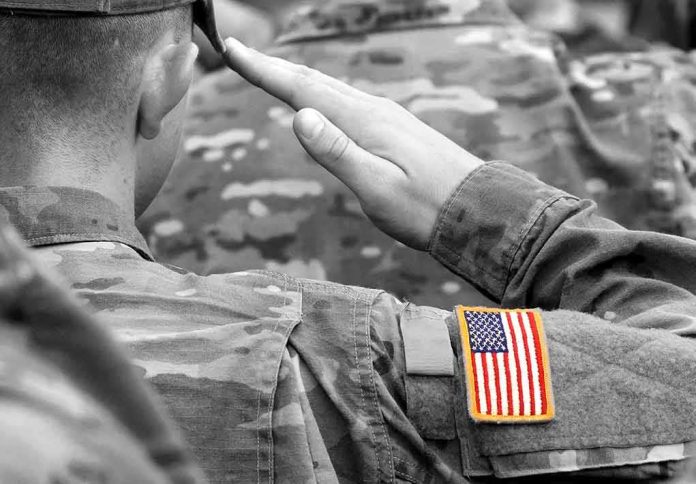
A U.S. Army lieutenant colonel stationed at a key NATO command post in England sat in a London jail cell this week, accused of spying for Russia.
Quick Take
- British counterterrorism police, the FBI, and U.S. military investigators worked together to arrest a senior Army officer in Gloucestershire.
- The suspect faces suspicion of offenses under Sections 1 and 3 of the UK National Security Act 2023, covering protected information and helping foreign spies.
- Reports identify him as Lt. Col. Brandon Carroll Tyner, an Afghan war veteran based at Imjin Barracks, home to NATO’s Allied Rapid Reaction Corps.
- A U.S. official says no sensitive information actually reached Russia, though American charges may still follow.
A Joint Raid Lands a Senior Officer in Custody
The U.S. Army confirmed one of its own was arrested as part of a UK Counter Terrorism Policing investigation run alongside American authorities, the U.S. military, and the FBI. Investigators searched two locations in Gloucestershire while the soldier stayed detained in London. The Army’s own statement pointed straight at Russia as the country tied to the allegations, leaving no ambiguity about the direction of the case.
The arrest falls under Sections 1 and 3 of the UK National Security Act 2023. Section 1 deals with obtaining or disclosing protected information. Section 3 covers helping a foreign intelligence service. Those are serious, specific charges on the books, not vague suspicion. The law lets British authorities hold a suspect without formal charges for up to 14 days while they build their case, which explains why the public has seen an arrest announcement but not yet a courtroom filing.
British outlets reported the officer held a senior role entrusted with sensitive information, and he was based at Imjin Barracks, which hosts NATO’s Allied Rapid Reaction Corps. That posting matters. This is not some obscure desk job. It’s a command tied to NATO’s ability to move forces fast in a crisis, exactly the kind of target a hostile intelligence service would want inside.
Who Is the Man Behind the Headlines
Multiple outlets, citing people familiar with the investigation, identified the suspect as Lt. Col. Brandon Carroll Tyner. The New York Times reported he’s an Afghan war veteran, the kind of resume that makes the allegation sting even harder for colleagues who served alongside him. CBS News reported the arrest followed a sting operation, though the public record so far doesn’t spell out exactly how investigators lured him in.
A U.S. official told NBC News that Tyner never actually handed over information to Moscow and that nothing classified made it into Russian hands. That’s a meaningful detail. It suggests investigators may have caught him before any damage was done, not after the fact. Still, under British law, attempting to assist a foreign intelligence service can itself be a crime, whether or not the handoff succeeds.
The Kremlin, for its part, brushed the whole thing off. Spokesman Dmitry Peskov said the arrest “does not concern us in any way” and claimed Moscow has “nothing to do with this”. Russian officials deny nearly every espionage accusation leveled against them, so that denial carries little weight on its own. It’s worth noting anyway, since it’s the only on-record response from the country at the center of the allegation.
This Fits a Pattern That Goes Back Decades
Americans with security clearances selling secrets to Moscow is not a new story. CIA officer Aldrich Ames spied for Russia for nearly a decade before his 1994 arrest. FBI agent Robert Hanssen did similar damage from inside his own agency. More recently, former Army Green Beret Peter Debbins was charged in 2020 with feeding Russian intelligence information about his unit’s activities over more than ten years. Each case started the same way this one did: an arrest, a set of allegations, and a long road to proof.
US Army officer Brandon Tyner has been arrested in the United Kingdom on allegations of spying for Russia.
Tyner is a 41-year-old Lieutenant Colonel taken into custody by British counter-terror police at his home on Tuesday, November 10th, 2026. At the time of his arrest, he was… pic.twitter.com/QOLweb2N1N
— Spycraft101 (@spycraft101) November 16, 2026
What separates these cases historically is how much evidence eventually surfaces once charges are filed. Nicholson, Ames, and Hanssen all faced detailed indictments laying out dates, documents, and handlers. Tyner’s case hasn’t reached that stage publicly yet. American officials have signaled charges are likely coming, which would finally put specifics on the record for a public that, right now, knows the accusation but not the full evidence behind it.
What Comes Next for the Officer and the Case
British prosecutors must decide whether to formally charge Tyner before his detention window closes. If they do, expect a charging document that spells out dates, alleged contacts, and what, if anything, changed hands. American officials have also indicated separate U.S. charges could follow, which would mark a rare instance of a sitting Army officer facing espionage allegations on both sides of the Atlantic at once. For now, the case stands as a serious allegation against a trusted officer, working its way through the system that exists for exactly this kind of threat.
Sources:
taskandpurpose.com, independent.co.uk, cnn.com, nbcnews.com, thehill.com, nytimes.com