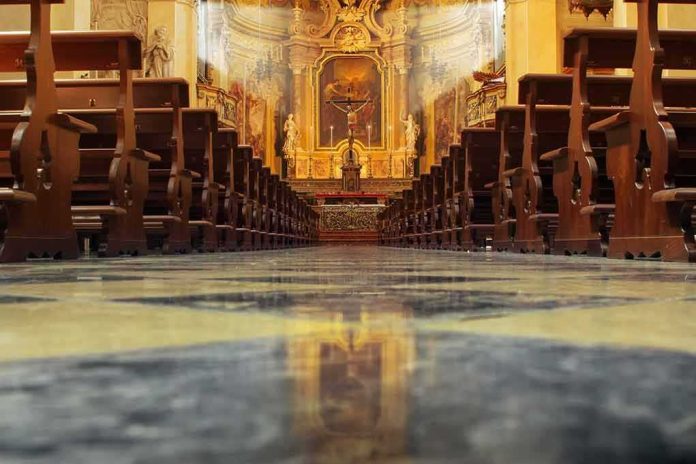
A New Jersey Democratic lawmaker said she stopped going to church because Republicans were there, turning a Sunday ritual into a partisan flashpoint.
Story Snapshot
- A New Jersey Democrat linked her church absence to Republican presence, drawing fast backlash.
- Republican members cited faith, speech, and safety in houses of worship to counter her stance.
- The comment touched the long-running “God gap,” where frequent worshipers lean Republican.
- Research shows politics and pews have grown more sorted over time, boosting friction.
The remark that jolted a routine Sunday
A Democratic member of the New Jersey Legislature told listeners she stopped attending church because Republicans were there. The statement spread through state political channels and conservative media, and it quickly sparked responses from Republican lawmakers. One Republican assemblyman, an ordained church deacon, stressed that faith communities handle sharp speech without banning people for their views, arguing that “hate speech is not free speech,” a line he has voiced in committee debates on religion and expression. The clash moved a worship choice into a political fight.
Republicans framed the lawmaker’s stance as a swipe at pluralism inside sacred spaces. Their argument ran on familiar lines: churches must stay open to sinners and saints, Democrats and Republicans, neighbors and strangers. Conservative members in New Jersey also pointed to ongoing efforts to protect congregations from rising threats, such as proposals to allow trained congregants to carry arms inside houses of worship to deter attacks, reflecting security priorities that many worshipers share today. To them, presence is not the problem; violence and intimidation are.
Why this landed with such force
The reaction did not come just from the words, but from where they landed. Church attendance in the United States links closely with party identity. People who attend weekly or more have long leaned Republican at the ballot box, a pattern documented in national surveys since at least 2004. That divide has helped sort congregations by ideology over time. When a Democrat says Republicans in the pews drove her away, many hear a broader message: politics now sets the guest list for worship. That is why a personal choice sounded like a public shot.
Political sorting in churches has been building for decades. Analysts have shown that Republicans report higher rates of regular attendance than Democrats, while many Democrats show lower attendance or none at all. This split does not mean that sermons become campaign rallies. It does mean that social life around worship often reflects red and blue habits. As a result, a mixed congregation can feel rare, and comments like this one hit nerves that are already raw.
Faith, speech, and the line inside the sanctuary
Republican lawmakers in New Jersey pushed a counterpoint rooted in civic and religious tradition: churches are among the last local places where political enemies still meet, sing, serve, and grieve together. They argued that offensive or harsh words do not erase the right of people to gather and speak, and that leaders should reject bans based on party identity. One Republican assemblyman tied his view to his own role as a deacon and his past statements on the limits of speech that crosses into hate and threats. That stance aligns with a conservative view that defends robust speech but condemns targeted abuse.
Safety adds another layer to this debate. After attacks on synagogues and churches in recent years, lawmakers in New Jersey, from both parties, explored ways to harden soft targets. One path would allow trained members to carry guns inside services when security is thin, a move backers say would protect all congregants regardless of party. That focus on defense contrasts with the lawmaker’s emphasis on who sits in the pew. The right sees protection of worshipers, not partisan gatekeeping, as the urgent need.
What common sense suggests now
The claim may play well to partisans online, but it sets a poor norm for civic life. If Republicans can drive a Democrat from church, then Democrats could drive Republicans from unions, or conservatives could drive liberals from school boards. That is not a road most Americans want. The better test is simple: if a person is peaceful, let them worship. The country has argued for 250 years, but it still bows its head together on Sunday. Keeping that space open is the wiser course.
Sources:
townhall.com, observer.com, pewresearch.org, njgop.org