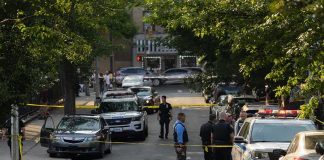
Police say a man advanced with a bladed tree trimmer, ignored commands, and was shot dead in Boyle Heights.
Story Snapshot
- Officers say the man kept coming after commands to drop the weapon.
- The weapon was a long pruning pole with a serrated blade, collected as evidence.
- Police tried to create distance before the shooting, according to reports.
- The call began as a report of a man swinging a pipe and a possible mental health case.
Commands, Advance, and a Split-Second Shot
Los Angeles police officers shot and killed a man late Monday morning in Boyle Heights after they say he ignored orders to drop a weapon and advanced toward them. The shooting happened near Gillette and Bridge Streets around 9:54 a.m. Officers had responded to reports about a man swinging a pipe and possibly in a mental health crisis. Police say they gave clear commands to drop the object. They say the man kept coming. An officer fired, and no one else was hurt.
Officials described the weapon as a pruning pole about 8 to 10 feet long with a serrated blade of 10 to 12 inches at the end. That is a pole saw, not a stick. Police say they recovered the tool at the scene and booked it into evidence. The size, reach, and cutting edge of a pole saw can be deadly at close range. Officers reported trying to back up and change position before the man closed distance and the shooting occurred.
From “Pipe” Call To Bladed Pole: How Fast Scenes Shift
Dispatchers first put out a call about a man with a metal pipe. Responding officers then reported facing a man with a long tree trimmer. This change tracks with many fast-moving calls, where first reports use simple terms and details sharpen as officers arrive. The core point did not change: a person wielded a hard or sharp object and posed a threat. Police say the man ignored repeated commands and advanced, which is when an officer fired.
Los Angeles Fire Department crews arrived after the shooting and transported the man. Authorities did not release his name or the officers’ names in early reports. Police reported no injuries to officers or bystanders. That matches a close threat stopped quickly, before anyone else got hurt. Early coverage included the Los Angeles Police Department’s statement that an officer fired after the advance continued despite orders to drop the pole.
What Comes Next In A Force Review
The Los Angeles Police Department said investigators are reviewing body-worn camera video, any other video, and statements from officers and witnesses. The Force Investigation Division and the County District Attorney conduct parallel reviews in such cases. That process typically evaluates commands, distance, timing, and whether deadly force met the legal standard. Police say the team will also look at whether a crisis or impairment factor was present during the encounter.
#BREAKING: LA Fire says a suspect was transported to the hospital with a gunshot wound after the LAPD responded to reports of a man armed with a pipe in Boyle Heights Monday morning. https://t.co/bX0OmaLKms pic.twitter.com/P8YD08T4UV
— KTLA (@KTLA) September 7, 2026
Recent data shows many police shootings in Los Angeles involve people holding sharp or blunt objects, often during a behavioral crisis. A review by the Los Angeles Times found about 27 percent of shootings involved edged weapons in recent years, and many ended in death. That pattern pushes training toward time, distance, and cover. Still, when a person closes fast with a blade, police often argue they have seconds to act to stop a lethal strike.
Why The Object Matters: Reach, Edge, And Injury Risk
A pruning pole’s reach lets a person cut or stab from farther away than a knife. The serrated blade can slice tendons, necks, and arteries. When an officer faces a long-bladed tool at short range, the margin for error is thin. Reported efforts to step back and redeploy align with sound tactics, but tactics end when the gap vanishes. On the facts reported so far, the account supports a defensive use of force under common sense and the law’s reasonableness test.
Sources:
nypost.com, ktla.com, abc7.com, mynewsla.com