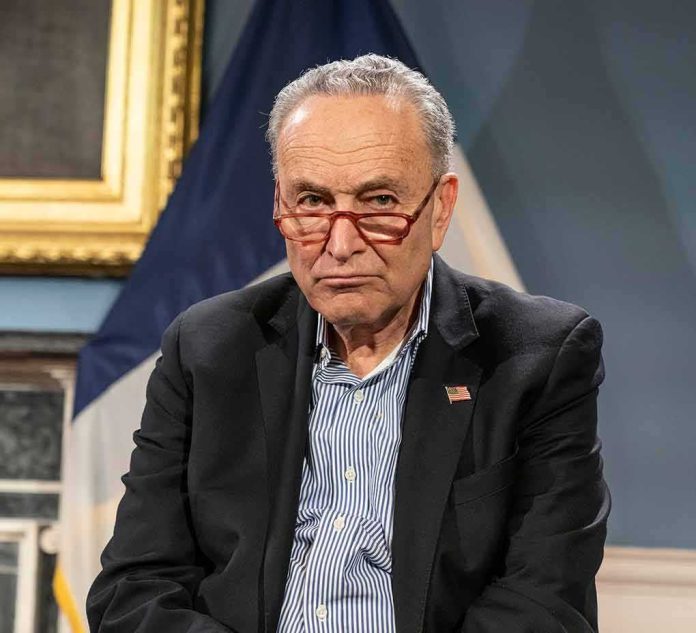
Chuck Schumer blamed Trump’s policies for high costs, then dodged a hard question about Democrats’ own record.
Story Snapshot
- Schumer ties today’s price pain to Trump’s tariffs and Republican policy choices.
- Schumer cites a $17,500 hit to new-home construction costs from tariffs.
- Republicans say Democrats caused the affordability crisis and blocked fixes.
- Extending Affordable Care Act premium tax credits can lower premiums, per the Congressional Budget Office (CBO).
Schumer’s Affordability Charge: Tariffs And Health Costs
Senate Democratic Leader Chuck Schumer says the affordability crunch flows from Trump-era choices. He points to tariffs that he argues raised the cost to build a new home by $17,500, a figure he has repeated on the Senate floor. That line is blunt and sticky because it speaks to buyers who feel shut out of the market. He also frames higher health costs as the result of Republican resistance to extending Affordable Care Act premium help and other cost controls, placing blame squarely across the aisle.
That message works because it links a visible pain, like a mortgage payment that will not pencil out, to a single lever. Tariffs are easy to picture: a tax on inputs that shows up in lumber, steel, and fixtures, and then in the sticker price. Health premiums are similar. The Affordable Care Act’s premium tax credits cut what people pay each month. If Congress lets stronger credits lapse, out-of-pocket premiums go up for many buyers, which households feel right away.
What The Numbers Say About Premium Help
The Congressional Budget Office has been clear on one narrow point. Extending the expanded Affordable Care Act premium tax credits lowers what eligible people pay for benchmark plans and keeps more people insured. If lawmakers do not extend them, average premiums paid by consumers rise and coverage falls. That is not campaign spin; it is the nonpartisan baseline for how the subsidy works in practice, even if it increases federal costs.
This matters because it separates two debates that often get mixed. One debate is about family budgets next month. On that front, stronger credits lower monthly bills. The other is about national debt. On that front, permanent expansion adds to deficits, as the CBO has estimated in other work. Voters can hold both ideas at once. Lower costs today come with a price on the federal ledger tomorrow. Honest policy keeps those trade-offs visible while targeting real relief.
Republicans Push Back And Claim The High Ground
The White House and the Republican National Committee counter that Democrats created the affordability crisis. They say Democrats blocked efforts to cut energy bills and other household costs, and that Republicans are the ones cutting taxes and tackling prices. This argument lands with voters who watched prices rise and now expect accountability from those in charge. It also challenges Schumer’s habit of shifting focus to Trump when pressed on Democratic votes.
On balance, the Republican claim needs proof in specific bills and measurable savings. Vague boasts do not pay the electric bill. But Democrats do not get a free pass either. When Schumer leans on “but Trump” and sidesteps questions on his caucus blocking proposals to lower utility costs, that weakens his message. Voters expect leaders to defend their record, not sprint from the podium. Common sense says show the math, take the heat, and explain the plan.
Tariffs, Housing, And The Limits Of Blame
Schumer’s $17,500 tariff figure is a bold charge because it personalizes a broad policy into a family-size bill. If a tariff raises building inputs, new homes cost more. That is credible directionally and matches industry warnings. Still, housing pain also rides on interest rates, zoning, labor, and land. Tariffs can add to the burden but rarely explain the whole mortgage. Voters smell spin when a complex mess gets pinned on one knob, even if the knob is real and costly.
Tariff revenue also makes a weak piggy bank for health or housing programs. Even at 2025 levels, analysts warned tariff money is not a stable way to fund major health plans and tends to be channeled toward favored groups. That undercuts any claim that tariffs can both shield industries and bankroll broad affordability promises. Policymakers should not sell the same tariff dollar twice and call it a windfall. Households need steady relief, not budget tricks.
What A Serious Affordability Plan Should Look Like
A durable plan starts with simple, verifiable steps. If leaders want to cut health premiums now, extend stronger Affordable Care Act credits and say how to pay for them within the budget window. If they want cheaper homes, speed permits, open more land to building, boost trade where it cuts input costs, and train more skilled workers. If they want lower energy bills, expand supply and transmission, improve reliability, and stop blocking cost-saving projects out of election fear.
Schumer’s case against tariffs and for premium help speaks to real pain. Republicans’ charge that Democrats duck accountability also hits a nerve. Voters do not need heroes. They need results that show up on the receipt. The winning side will be the one that names the cost driver, proves the fix, and takes ownership when the cameras turn off.
Sources:
forth.news, washingtonexaminer.com, govinfo.gov, democrats.senate.gov, congress.gov, yahoo.com