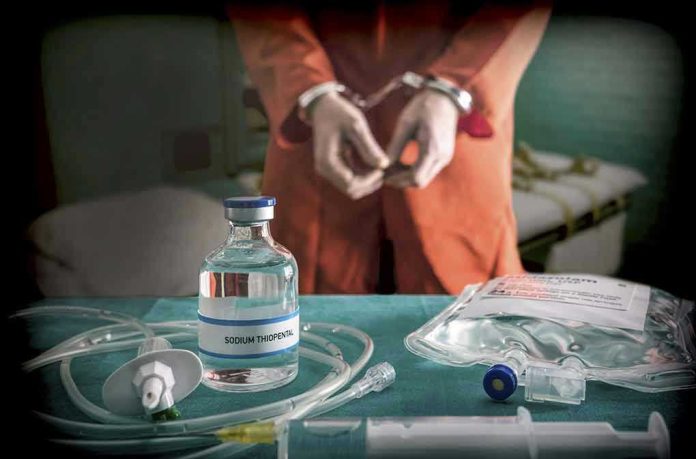
The most advanced state power on earth just stopped at the same place a rookie nurse often does: the hunt for a usable vein.
Story Snapshot
- Tennessee halted death row inmate Tony Carruthers’ execution after staff failed for over an hour to secure the veins required by protocol.[1]
- The Tennessee Department of Correction says a primary line went in, but the required backup and a central line did not, forcing a stop.[1]
- Governor Bill Lee issued a one-year reprieve, leaving the death sentence intact but the timetable scrambled.[2]
- The incident exposes a larger problem: lethal injection depends on medical skills the prison system struggles to perform consistently.
When The Needle Stalls, The Entire Machinery Of Justice Shudders
Tennessee correctional officials walked into the execution chamber expecting a precise, scripted procedure; instead, they met the stubborn reality of human anatomy. Witnesses and attorneys say medical staff spent more than an hour trying to secure intravenous access before the execution was halted.[1][3] The Tennessee Department of Correction later stated that personnel quickly placed a primary intravenous line but could not secure the required backup line, even after attempting a deeper central line.[1] Without both, the protocol stopped them cold.
That backup line is not some bureaucratic nicety; it is the state’s safety net. Tennessee’s lethal injection protocol requires a secondary line so the drugs can still flow if the primary fails.[1] In theory, this protects the inmate from prolonged suffering and protects the state from a visibly “botched” killing. In practice, on that morning, the requirement turned into a brick wall. When the central line attempt also failed, officials called off the execution, and the carefully choreographed final act of punishment dissolved into confusion.[1]
The One-Year Reprieve: Pause Button, Not Pardon
Governor Bill Lee’s response was swift but narrow. He issued a one-year reprieve, pushing any new execution date into the future while leaving the conviction and death sentence untouched.[2] The reprieve acknowledged that something had gone wrong inside the chamber, but it did not declare the punishment unjust or unlawful. From a common-sense conservative perspective, that distinction matters; a temporary delay respects the courts’ judgment while recognizing the state’s obligation to carry out sentences competently, not haphazardly.
Carruthers’ attorneys, however, moved immediately to frame the failed attempts as more than a mere technical glitch. They filed emergency motions arguing that repeated, painful efforts to access veins crossed the line into “cruel and unusual punishment.”[1][3] Advocacy groups amplified that language, describing the effort as a “tortured, botched execution” and tying it to broader claims about potential innocence and the need for more forensic testing.[3] Those assertions remain legal and political arguments, not findings from a court, but they land powerfully in a public already uneasy about execution mishaps.
What Really Failed: Veins, Protocol, Or System Design?
Reports do not yet include a detailed incident log from the Tennessee Department of Correction, but they offer enough to see the fault lines.[1][2] Staff claimed they followed protocol, escalated to a central line when peripheral veins did not cooperate, and stopped when they could not proceed within the rules.[1] On paper, that sounds like due diligence. Yet the image from witnesses—an inmate repeatedly stuck, groaning, while professionals chase a vein for an hour—raises hard questions about whether the system is asking the wrong people to do the wrong job under the worst possible conditions.[1][3]
Lethal injection was sold decades ago as the “medicalized,” more humane alternative to older methods. But prison systems are not hospitals, and execution teams are not intensive-care-unit anesthesiologists. Tennessee is now one of multiple states that have had to halt or delay executions because intravenous access failed or lethal drugs were not fully vetted.[1][3] From a conservative, law-and-order angle, that is not just an ethical embarrassment; it is operational incompetence that undermines confidence in the state’s most serious sanction.
The Conservative Dilemma: Competent Justice Or Creeping Chaos?
Americans who support the death penalty typically do so for reasons of accountability, deterrence, and respect for victims’ lives. Those values assume a system that is accurate, transparent, and capable. When a state cannot reliably perform the mechanics of the punishment it has chosen, two dangers emerge. First, the public starts to see executions less as solemn enforcement and more as grim experiments. Second, courts and activists gain ammunition to chip away at the death penalty not by changing minds on morality, but by proving repeated governmental failure.
NASHVILLE, Tenn.— Gov. Bill Lee granted a one-year reprieve Thursday after Tennessee halted the planned execution of death row inmate Tony Carruthers amid reported problems establishing IV access for the lethal injection. https://t.co/HDR9I44dko
— wake1up (@n2oneness) May 22, 2026
One response would be to shrug and treat the Carruthers incident as an unfortunate but fixable hiccup: review the protocol, bring in better-qualified medical professionals, and try again after the reprieve. Another path would be harder but more honest: admit that lethal injection has become a technical trap of our own making. Tennessee already lives under scrutiny for previously using untested drugs in executions.[1][3] Adding high-profile vein failures to that history does not project strength; it projects a government out over its skis.
What Comes Next If The Veins Keep Losing?
The next year will quietly determine whether Tennessee doubles down on lethal injection or rethinks how, or whether, it uses capital punishment at all. If officials release a detailed incident report, tighten procedures, and show they can carry out a sentence without an hour-long needle hunt, some public trust may be restored. If they stonewall, rely on vague summaries, and stumble into another failed attempt, they will hand abolitionists a simple narrative: the state cannot be trusted with this power, not because it is too harsh, but because it is too clumsy.
Sources:
[1] Web – Tennessee halts man’s execution after failing to find a vein for …
[2] YouTube – Tony Carruthers granted reprieve from execution after failed …
[3] YouTube – Witnesses describe moments before Tony Carruthers’ execution …